
Over the past few years, leadership conversations have been dominated by topics like AI, automation, and productivity. But in many companies, one of the hardest questions today is much more human:
How often should people be physically together?
Not because we lack tools. Not because we lack flexibility. But because culture, trust, and collaboration are still deeply human experiences.
The Distributed Team Reality
At C Wire, we built a team spread across countries. This gives us clear advantages. We can access great talent regardless of location. We gain flexibility. We become more resilient as a company. And frankly, it reflects the modern reality of work. But there’s a hidden challenge that doesn’t show up in spreadsheets:
How do you build one culture when people don’t share the same physical space?
One of the risks I’ve become increasingly aware of is the emergence of sub-cultures. If some people are always remote, others mostly office-based, and policies differ between groups, you risk creating different working realities. Over time, this can quietly fragment a company’s culture. Not because anyone intends it, but because people experience the company differently. That fragmentation is subtle. And may or may not be dangerous.
The Power of Informal Communication
Call me old-fashioned but I strongly believe in the value of being physically together. Not only for structured meetings. Those can happen perfectly well on video calls. But for everything that happens around the meetings. The quick question between tasks. The spontaneous idea that starts during lunch. The moment where someone overhears something and connects dots that weren’t visible before. These moments are incredibly difficult to replicate through digital tools.
Technology has improved dramatically. Collaboration tools are better than ever. But I’m not convinced human nature adapts fully to digital communication. There is still something uniquely powerful about proximity. Trust builds faster. Alignment happens more naturally. Misunderstandings get resolved quicker. And culture, the invisible glue of any organization, grows stronger.
The Trap of Rigid Policies
At the same time, forcing people into the office without context doesn’t work either. Distributed teams exist for a reason. People have different lives, different constraints, and different working styles. Flexibility isn’t just a perk anymore, it’s part of how modern companies function. That’s why I’m skeptical of rigid, one-size-fits-all rules. But I’m equally skeptical of fully unstructured remote models that leave physical presence to chance. Both extremes have trade-offs. The real challenge is finding something that balances flexibility with shared experience.
Our Current Experiment
Like many companies, we’re still figuring this out. There is no perfect formula, and I doubt one exists. But we’ve started experimenting with a simple structure that tries to combine flexibility with intentional presence. At C Wire, our current model includes:
A yearly full-team offsite
This is where everyone comes together, regardless of location. It’s about connection, reflection, strategy, and strengthening relationships beyond daily work.
Regular Collaboration Days
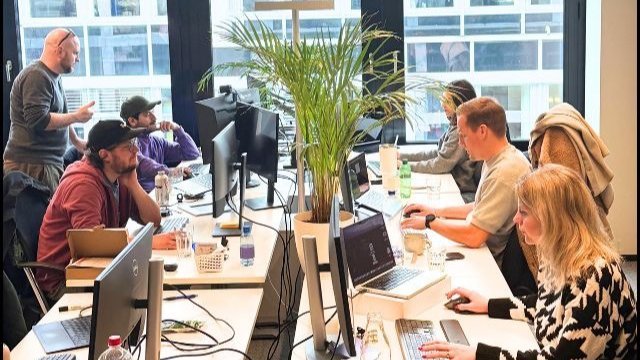
We bring teams together in the office for dedicated collaboration periods, typically two days focused on working side by side. Not for symbolic presence. Not for control. But for interaction.
Work happens differently when people are in the same room. Faster. More fluid. Often more creative. These days may become some of the most valuable moments in our calendar, not because of what we plan, but because of what happens organically.
Leadership in the Era of Distributed Work
I increasingly see office presence not as a logistical decision, but as a leadership decision.
It shapes culture. It shapes communication. It shapes how people feel about belonging. And most importantly, it shapes how companies evolve.
Leaders today are navigating something new. Previous generations didn’t have to design hybrid culture models. They inherited physical workplaces by default.
We don’t. We have to design them intentionally. That’s both the challenge and the opportunity.
There Is No Universal Answer
One thing has become clear to me: there is no single model that works for every company.
Industry matters. Team composition matters. Company maturity matters. Leadership philosophy matters.
What works brilliantly in one organization may fail completely in another. That’s why this topic deserves open discussion rather than rigid dogma. Because behind every policy is a deeper question:
What kind of company are we trying to build?
An open question to other leaders
We’re still learning. Still adjusting. Still experimenting. And that’s why I’m genuinely curious how others are approaching this.
- How do you balance flexibility with culture?
- How do you avoid creating sub-cultures in distributed teams? (if you even intend to prevent it)
- What has worked and what hasn’t in building strong teams across distance?
Because if there is one thing I’m certain about, it’s this:
The future of work won’t be defined only by technology but by how we design human collaboration around it.