Sora Dies, Agentic AI Arrives, and the Holdco Standoff: The Week That Re-wrote the Ad Playbook
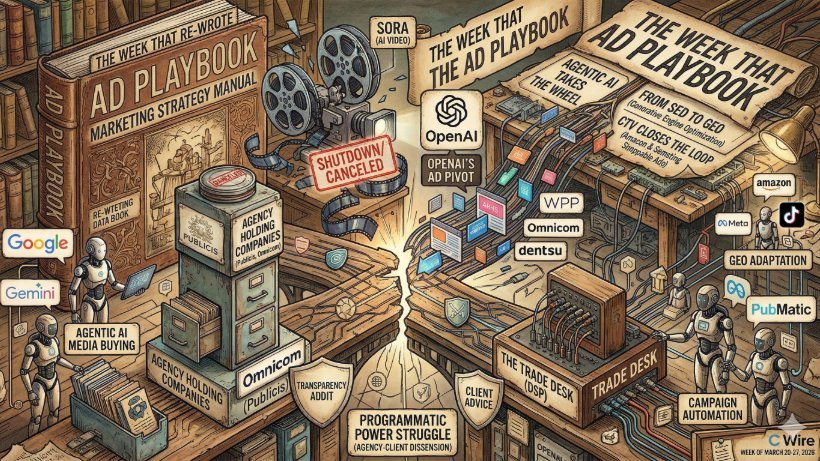
If you thought the digital advertising landscape was chaotic before, the last seven days just reset the baseline.
Welcome to this week’s C Wire "What happened last week" recap. We saw tectonic shifts that will likely redefine Q2 and beyond, ranging from a full-blown power struggle between holding companies and the world's leading DSP, to the sudden (and surprising) pivot of the world's most hyped AI lab.
The old playbook hasn’t just been updated; it’s being entirely rewritten in real-time. Here are the five seismic stories that are reshaping ad-tech, AI, and media buying.
1. The Programmatic Power Struggle: Holding Companies vs. The Trade Desk
A major power struggle has publicly erupted, exposing deep tensions within the programmatic advertising ecosystem. Following years of underlying conflict, Publicis Groupe took the unprecedented step of formally advising its clients against using The Trade Desk (TTD).
The industry had barely digested this news before Omnicom Media Group followed up, announcing a formal "Big Four" audit of TTD's fee structure.
Why it Matters: This isn't just about transparency; it is about margin control and supply-path optimization. As DSPs move closer to publishers and create direct relationships with advertisers, agencies are fighting to ensure they retain control over programmatic spend and margin allocation. This marks what many are calling the most transparent dispute in programmatic history and could fundamentally restructure the agency-vendor dynamic.
2. OpenAI's Big Pivot: Adieu, Sora; Hello, ChatGPT Ads
In a turn of events that shocked the creative world, OpenAI abruptly announced the shutdown of its much-hyped Sora video generation platform. In doing so, it terminated a massive, newly minted $1 billion partnership with Disney that was signed just three months ago.
Instead, OpenAI is now focusing aggressively on scaling its nascent advertising business within ChatGPT, which is already boasting a $100M+ annualized revenue run rate. To solidify this push, the company hired long-time Meta ads leader David Dugan as its head of global ads solutions.
Why it Matters: This pivot is a massive signal that generative AI’s monetization model has landed squarely on advertising. Hype over creative tools is yielding to the hard reality of scaling revenue. As OpenAI builds out its ads business with Meta-level talent, it isn't just a technology partner anymore—it’s a formidable, emergent competitor to the digital ad duopoly.
3. Agentic AI is Officially Buying Your Media
Last week, "AI in ad-tech" moved decisively from a hypothetical buzzword to an active execution phase. We saw two major launches that prove autonomous agents are taking the wheel.
Google announced the deep integration of its Gemini AI into Display & Video 360 (DV360), aiming to curate media packages and automate complex planning. Simultaneously, PubMatic deployed AI agents to completely automate programmatic campaign planning and execution, partnering with a dozen independent agencies.
Why it Matters: We are witnessing the sunsetting of the manual media buying era. The role of the agency is shifting from "executor" to the "operating system" that manages these autonomous agents. This increases efficiency, reduces human error, and demands a entirely new skillset from media planners and buyers.
4. From SEO to GEO: Generative Engine Optimization Rewrites the Playbook
The traditional search playbook is collapsing. AI chatbots, search summaries (like Google’s AI Overviews), and "answer engines" (like Perplexity) are siphoning traffic from traditional publishers at an alarming rate, with some niche tech sites reporting traffic drops of up to 97%.
This "traffic siphon" is having a dual effect: it is making premium, human-vetted ad inventory on publisher sites exponentially scarcer and more valuable, while also forcing a shift in search strategy. Marketers are no longer prioritizing SEO; they are pivoting to GEO (Generative Engine Optimization).
Why it Matters: The traditional page-rank model is dead. In the AI era, visibility no longer depends on achieving a high search ranking; it depends on being cited as a trusted source within the AI’s answer summary. Advertisers must shift their focus to ensuring their content is ingestion-ready and authoritative enough to be the source that the AI chooses.
5. Shoppable CTV Finally Closes the Loop (Thanks to Amazon & Samsung)
Shoppable TV took its single biggest leap forward last week. Amazon DSP announced a strategic partnership with Samsung TV Plus to introduce "add to cart" functionality directly within Samsung’s free FAST channels.
Viewers can now use their TV remotes to purchase products instantly, closing the distance between entertainment and a final transaction.
Why it Matters: While other CTV players are still discussing "content-to-commerce" concepts, Amazon has officially deployed the infrastructure to closed the loop in the living room screen. This shifts CTV from an upper-funnel branding play to a measurable, bottom-funnel performance channel. It turning the big screen into a retail media monster and provides the attribution metrics that advertisers have been craving.
We are no longer living in the age of gradual change. The simultaneous arrival of agentic buying, the total disruption of search, the solidification of AI ad models, and the restructuring of programmatic power dynamics are not isolated events.
They are all pieces of a single, rapidly converging trend: the absolute automation of the digital advertising ecosystem. Adaptability, once a differentiator, is now the only strategy for survival.
Which of these shifts is going to disrupt your Q2 roadmap the most?