Sir Martin Sorrell and the Wrong Question About AI
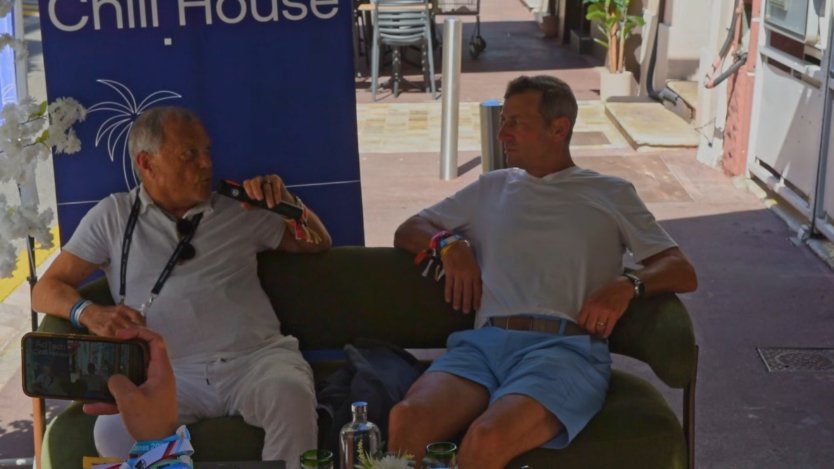

A back room, a fireside, and one uncomfortable sentence
During Cannes Lions 2026, we opened the doors of the AdTech Chill House and sat Sir Martin Sorrell down with Tom Triscari for one of our Founder Cannes Confessionals. No slides, no script. Just a candid "street talk" about where the industry is actually heading.
At 81, and with WPP and S4 Capital behind him, Sir Martin has watched more advertising cycles than almost anyone alive. So when he said the industry is looking at the wrong thing, the room went quiet.
"They're too focused on the impact of AI on creative. They should be focused on the impact of AI on media planning and buying."
Walk La Croisette this year and you'd think the whole future of advertising rested on whether a model can write a sharper headline or generate a slicker film. That's the loud debate. It's also, in Sir Martin's view, the wrong one.
The disruption is one layer down
Creative is where the noise is. Planning, buying and pricing is where the money moves.
Sir Martin pointed to a handful of shifts that matter more than better copy: AI compressing the time and cost of getting work made, personalization delivered at scale, and, tellingly, a change in the commercial model itself, toward output-based pricing.
That last point deserves more attention than it got in the room. For decades, the industry has been paid for inputs: hours, headcount, media volume. A move toward pricing on outputs and outcomes rewires the incentive structure of the entire supply chain. It's a quieter revolution than "AI makes ads," but a far more consequential one.
This is the layer C Wire was built for. Not the creative canvas, but the buying engine underneath it.
"The answer is human beings"
If there was a surprise in the conversation, it was where Sir Martin landed on the human question.
Quoting a call with Coca-Cola's James Quincy, he framed the paradox plainly: if everyone has access to the same AI and everyone personalizes at scale, how does any brand actually stand out?
"The answer is human beings. At least until machines become more powerful than people."
We read that not as nostalgia but as strategy. When the tooling becomes universal, the differentiator moves. Judgment, taste, context and trust become the scarce inputs. The winners won't be the teams with the most automation. They'll be the teams that point good automation at the right decisions.
Control by opacity is ending
Sir Martin was blunt about how parts of this industry have historically operated. He recalled a line from 2016, when an executive described his own model as being "transparent about being not transparent," and connected it to a broader truth about power in advertising:
"AI is democratizing knowledge. AI is flattening organizations. The way people in our industry and clients control is by controlling information. Game over."
Game over.
For anyone who has built their advantage on being the only one who can see inside the box, that's an uncomfortable forecast. For anyone building the alternative, it's a mandate.
C Wire's thesis has never been complicated: the trusted web doesn't need surveillance, opaque take-rates or black boxes to work. It needs context, and it needs buyers and publishers who can actually see what they're paying for and what they're getting. Sir Martin's point, that information asymmetry is a dying business model, is the tailwind behind that bet.
A note for the sell side
One aside from the session is worth repeating for every adtech and publisher team reading this. Asked what he tells businesses in our space, Sir Martin's advice was refreshingly unglamorous:
"If you can pay [publishers] in 30 or 45 days, you've got very happy publishers."
The players stretching payment to 120 or 150 days, he noted, are the ones whose supply is quietly draining away. In an agentic, automated market, healthy publisher relationships aren't a nicety. They're inventory. They're the whole business.
What we took away
Strip out the Cannes theatre and the message is simple. The industry is watching the creative screen. The disruption is happening on the buying screen. And the durable advantages in the next cycle will belong to whoever pairs good automation with human judgment, and does it in the open.
That's the shift from handwork to automation we talk about every day at C Wire: the agentic buying OS for the trusted web. No cookies, no IDs, no black boxes.
Grateful to Sir Martin Sorrell for the candour, and to Tom Triscari for moderating. The full session is above. More from the Cannes Confessionals is on the way.
Want to see what agentic buying looks like without the black box? Get in touch with the C Wire team.