From AI buzzwords to execution: What we learned at ADZINE Connect Düsseldorf
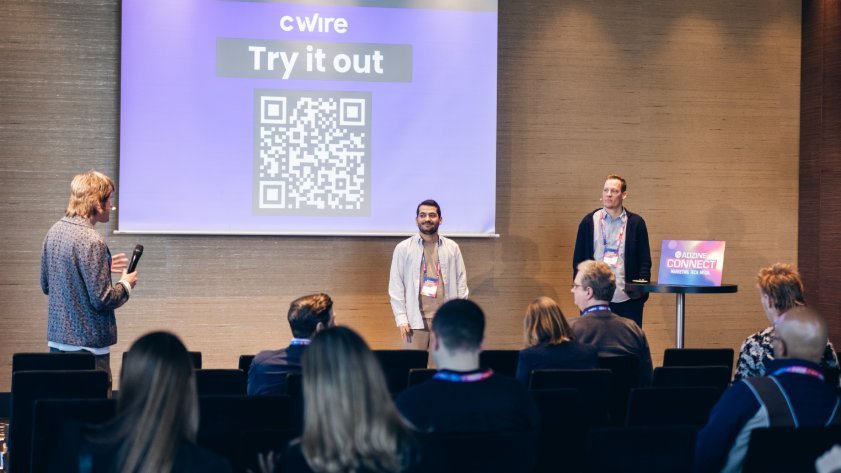
Last week, C Wire had the opportunity to host a masterclass at ADZINE Connect 2026 in Düsseldorf together with Martin Garling and Rui de Freitas. The session focused on a question that is becoming increasingly important for the advertising industry:
How do we build relevance in a world where identifiers are disappearing, fragmentation is increasing, and expectations on performance continue to rise?
The answer, we believe, lies in a new paradigm: agentic advertising.
Moving beyond static targeting
For many years, digital advertising has relied on relatively static systems. Campaigns are configured manually, targeting segments are defined in advance, and optimization often happens through incremental adjustments.
But the environment around advertising has fundamentally changed.
Identifiers are disappearing.
Consumer journeys are fragmented across devices and platforms.
Media environments are becoming increasingly dynamic.
In this context, traditional campaign structures are reaching their limits.
What is needed is not simply better targeting, but a system that can understand strategy, translate it into activation logic, and continuously optimize execution.
This is where AI agents come into play.
The foundations of Agentic Advertising
During our masterclass, we introduced the fundamental layers we are building to power an agentic advertising ecosystem.
At the core of this approach is the idea that advertising should operate as an intelligent system rather than a collection of disconnected tools.
The foundation starts with Brand DNA.
Brand DNA captures the strategic identity of a brand: its positioning, tone, values, audience ambitions, and communication objectives. This strategic layer becomes machine-readable and serves as the reference point for all campaign decisions.
On top of that sits Campaign DNA.
Campaign DNA translates strategic objectives into structured instructions that define what a campaign should achieve, which signals matter, and how success should be evaluated.
Once these layers are defined, AI agents can take over parts of the execution process.
These agents dynamically interpret signals, identify relevant audiences, adapt activation logic, and continuously optimize outcomes in real time.
Instead of manually configuring every step of a campaign, advertisers can move toward systems that act autonomously within defined strategic boundaries.
From concept to demonstration
One of the key goals of the session was to make the discussion as practical as possible.
To illustrate how agentic systems can work in practice, we shared a live showcase of our MatchPersona agent and our upcoming MatchCreative agent.
Participants were given a QR code during the session, allowing them to directly explore examples generated by the agents.
The demonstration showed how:
MatchPersona translates brand strategy into structured audience intelligence
AI agents can interpret contextual signals to identify relevant personas
creative concepts can be generated and adapted dynamically through the upcoming MatchCreative agent
Rather than simply presenting slides, the idea was to allow people to experience the outputs themselves and understand how these systems operate in practice.
The response was extremely encouraging. Many participants told us afterwards that this hands-on approach helped make the concept of agentic advertising much more tangible.
From theory to practical infrastructure
AI is currently one of the most talked-about topics in advertising. But many conversations remain highly conceptual.
What resonated with the audience was the focus on how agentic systems can actually work in real-world media execution.
The discussion covered practical questions such as:
How brand strategy can become machine-readable
How agents interpret signals from the media environment
How creative, audience definition, and media activation can be coordinated autonomously
How human oversight remains central in defining the strategic boundaries of these systems
In other words, the conversation moved from AI as a buzzword to AI as infrastructure.
Building a presence in Germany
The event also marked an important milestone for us at C Wire.
Just a little more than one year after launching the German market, it was remarkable to see how many familiar faces were in the room.
Conversations continued where they had left off months earlier. New connections were made, and the level of engagement confirmed something we deeply appreciate about the German market: the appetite for practical innovation.
For us, moments like this reinforce the feeling that we are building something meaningful within the ecosystem.
Germany has welcomed us incredibly warmly, and we are grateful for the openness of the community.
The beginning of a new advertising architecture
Agentic systems will not replace human strategy, creativity, or decision-making.
But they will change how advertising operates.
As the complexity of the media landscape continues to grow, the ability to translate strategic intent into autonomous execution will become increasingly important.
The shift toward agentic advertising is not about replacing marketers.
It is about giving them systems that can operate at the speed and complexity of modern digital environments.
At C Wire, we believe this shift is only beginning.
And the conversations at ADZINE Connect showed that the industry is ready to explore what comes next.